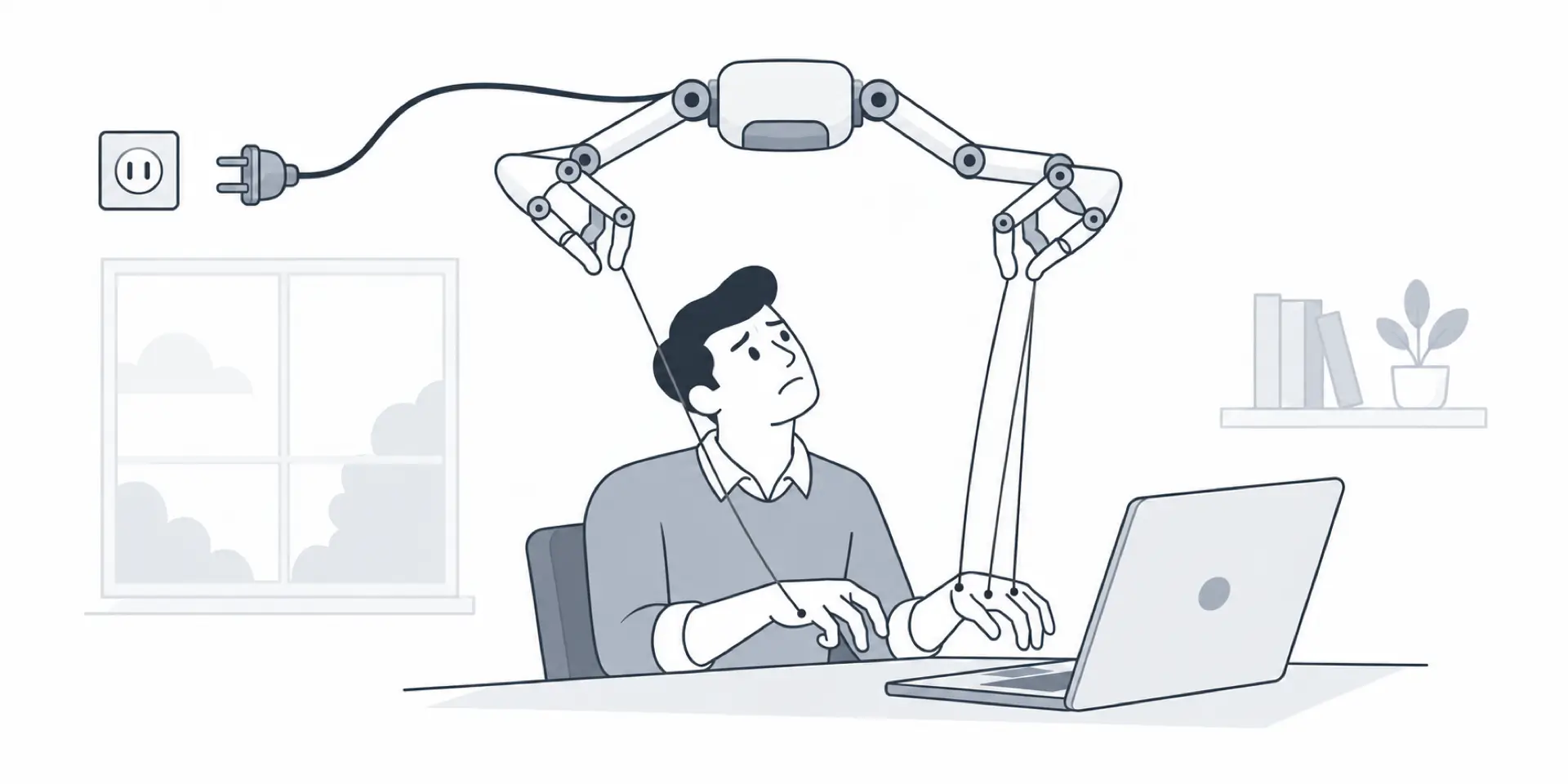
“If you’re nothing without this suit, then you shouldn’t have it.”
One of my favorite scenes from Spider-Man: Homecoming isn’t an action sequence. It’s Tony Stark taking away Peter Parker’s suit. Peter thinks he needs it because the suit gives him abilities he doesn’t have on his own. Tony disagrees: “If you’re nothing without the suit, then you shouldn’t have it.”
I think about that quote a lot when I see how we’re using AI.
I felt this myself
Recently, I was using AI coding tools to build something with a framework I didn’t know very well. I knew how to code basic things, but AI made it possible for me to work with technologies I hadn’t properly learned yet.
And honestly, it was great. I could build things much faster: ask the AI to write something, see the result, make changes, and keep moving.
Until I hit a rate limit.
Suddenly, I couldn’t ask AI what to do next, and I didn’t know what to do next either. I was looking at code that I had helped create, but I didn’t fully understand the framework or the language well enough to continue on my own. I felt frustrated, helpless, and a little embarrassed.
But it also made something very clear to me:
I had been using the tool faster than I was learning the skill.
So I started asking ChatGPT and Claude different questions—not just, “Write this for me,” but:
- “Why is this written this way?”
- “What is this doing?”
- “Why are we using this?”
- “What would happen if I changed this?”
I started using AI to understand the thing it had helped me build. And that, I think, is the difference.
AI can make you capable before you’re competent
This is where I think things get interesting. AI has made it incredibly easy to do things we don’t know how to do. A product manager can build an app without knowing much about programming. A marketer can generate a poster without knowing much about typography, hierarchy, spacing, or visual storytelling. A designer can generate code without understanding the underlying framework.
And I don’t think there’s anything inherently wrong with that. In fact, I think it’s great.
You should be able to use AI to explore things outside your expertise. The problem starts when exploration becomes a permanent shortcut: when you never stop to understand what you’re doing, and when AI becomes the only reason you can do the thing.
Because then you aren’t learning a new skill. You’re learning how to operate a button.
The shortcut eventually becomes the dependency
Most people will probably start learning. But I suspect many won’t. If AI can always write the code, why learn to code? If AI can always make the design, why learn design? If AI can always write the copy, why learn how to write?
The shortcut is incredibly tempting, and eventually, you can become dependent on it. You stop being the person who knows how to do the work and become the person who knows how to ask AI to do the work.
That’s a dangerous shift.
What happens when the tool isn’t available? Maybe it disappears, breaks, becomes too expensive, or the particular tool you’ve built your workflow around stops existing. Or maybe you simply need to solve a problem that requires understanding rather than generation.
At that point, the gap becomes obvious:
You haven’t lost AI. You’ve lost the ability to do the work yourself.
I’m actually glad AI wasn’t around when I learned to code
I started learning to code in 2019 because I wanted to build my personal website. Back then, if coding agents like today’s tools existed, I probably would have asked AI to build it for me. And I’m honestly glad I didn’t have that option.
Because I had to figure things out myself. I learned how code worked, how to fix things when they broke, how to experiment, and what was possible. As I understood more, I started getting more ideas.
That’s something I’ve noticed about learning any craft:
You start seeing possibilities only after you understand the thing you’re working with.
Learning to code didn’t just give me the ability to write code. It opened up a whole new way of thinking. I built my website, built side projects, and I’m still building things with it today.
There’s a kind of pride I get from knowing that I made those things with my own hands. I don’t quite feel the same way when I ask AI to make something for me. Sometimes it feels more like I paid someone else to make it.
The result might be good, but some of the joy is missing.
So, should we stop using AI?
Absolutely not. I use AI every day. It helps me brainstorm, challenges my ideas, helps me write code, helps me learn technologies faster, and helps me explore design directions. It’s become an important part of how I work.
But I don’t want AI to be the source of my ability. I want it to be the thing that amplifies my ability.
If AI writes some code for me, I want to understand what it wrote. If it gives me a design direction, I want to understand why it works. If it teaches me something, I want to eventually be able to reason about it myself.
Use AI as a direction, a teacher, a collaborator, or a tool. But don’t make it your entire skill set.
Learn the craft. Then bring AI into it.
There is a reason people spend years learning their craft. Designers learn hierarchy, typography, composition, interaction, and visual systems. Developers learn programming, architecture, data structures, and how systems work. Artists study anatomy, perspective, light, and composition. Musicians practice scales before they start improvising.
The fundamentals can feel slow—sometimes painfully slow. But eventually, they become instincts, and those instincts are what allow you to make decisions.
AI can give you ten design directions. Knowing which one is actually good is still your job.
AI can write a thousand lines of code. Knowing whether that code makes sense is still your job.
AI can generate an image. Knowing what you want the image to communicate is still your job.
That’s where the real value is.
Become someone AI can amplify
I don’t think the answer is to avoid AI. I think the answer is to use it differently.
Don’t just ask it to do the thing. Ask it to teach you the thing. Don’t just copy the code. Read it. Don’t just accept the design. Question it. Don’t just generate another option. Understand why one option is better than another.
Let AI remove the boring parts. Let it make you faster. Let it help you explore things you couldn’t have explored before. But keep building your own ability underneath it.
Because the goal isn’t to become someone who can do everything with AI. The goal is to become someone who can do more because AI is available.
Tony Stark wasn’t saying Peter didn’t deserve the suit. He was saying Peter needed to become Spider-Man first.
The suit was never the superpower.
Neither is AI.
The real superpower is the person using it.